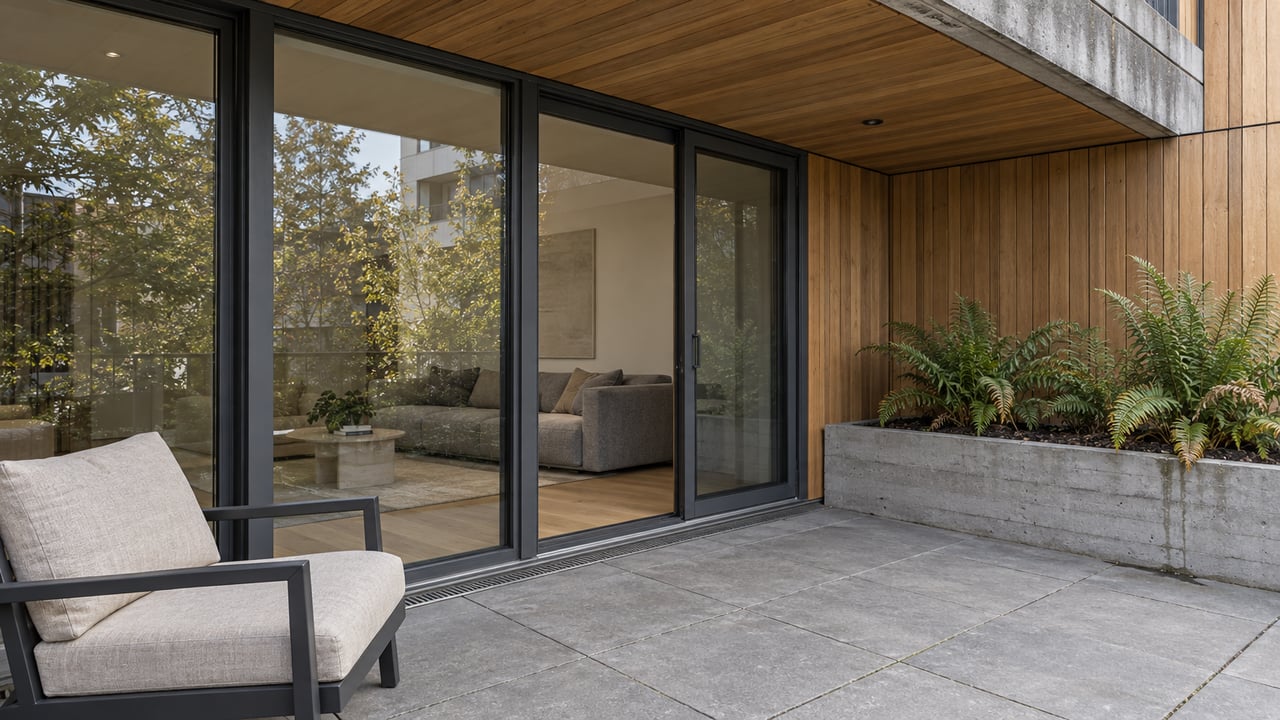
On July 14, 2026, Lunara opened its doors at 7750 SE 29th St. in Mercer Island's Town Center. That was nearly four months after light rail trains started stopping a few blocks north. The building has 146 apartments over four stories. The current owner and design team had been working on the site since 2018, and other teams had explored it before them. The Mercer Island Reporter put total project cost at about $80 million.
Over that decade, the project lost a story. It also lost 200 public parking stalls once meant for light rail commuters, according to The Urbanist.
The city now allows buildings twice that height. The thesis of this post follows from Lunara's history. On Mercer Island, changing the zoning has never been what limits new housing. What limits it is whether a project pencils out. Nothing in 2026 so far shows that rail access or the new code has added supply or raised home values.
Rail arrived on schedule. Housing arrived one building at a time.
Sound Transit's Crosslake Connection opened March 28, 2026, and trains began serving Mercer Island Station that day. Here is everything built in Town Center and right next to it since 2010:
| Building | Address | Height | Homes | Completed |
|---|---|---|---|---|
| Aviara Apartments | 2441 76th Ave SE | 5 stories | 166 | 2012 |
| The Mercer | 2558 76th Ave SE | 5 stories | 85 | 2014 |
| The Hadley | 2601 76th Ave SE | 5 stories | 209 | 2016 |
| Aegis Mercer Island, just outside Town Center | Behind the Hadley and Aviara | 4 stories | 89 | 2019 |
| Lunara | 7750 SE 29th St | 4 stories | 146 | Opened July 2026 |
The Urbanist counted 549 homes completed downtown since 2010, rising to 695 with Lunara. Before Lunara, that works out to about 37 homes a year from 2010 through 2025, in the area closest to a station that connects the island to Bellevue and Seattle.
The new building is filling up steadily. By late August, about 30% of Lunara's units were occupied and almost half were leased. The building's product vice president said there had been move-ins "pretty much every single week since we opened." Its leasing page currently lists studios from $2,100 and two-bedroom plans near $3,960 a month in base rent. Those are asking rents and may change. So renters are clearly showing up. Supply is what has been slow.
Why five stories became the only number that worked
The Urbanist reports that for about 30 years, builders treated five stories as the only height worth building in Town Center. The lower tiers of the "wedding cake" zoning did little to attract them. Even five stories came with conditions. Projects had to provide significant public benefits and meet strict design, green building and affordable housing standards.
In December 2024, the city tightened those conditions. It raised height limits slightly, but it also required 15% of units in four- to seven-story rental buildings to be affordable at 50% of area median income. The Urbanist described that as one of the strictest requirements in the region. Each new requirement makes it harder for a project to cover its costs. More height helps a project only when the extra units bring in more revenue than the conditions attached to them cost.
A state order rewrote the rules
The latest change began with a legal challenge. The timeline:
- February 2025. Futurewise, Kian Bradley and Trevor Reed appealed Mercer Island's 2024 comprehensive plan update to the Growth Management Hearings Board.
- August 1, 2025. The Board found the plan out of compliance. It cited the city's housing capacity analysis, its affordable housing provisions, the lack of a station-area subarea plan, and the lack of anti-displacement measures.
- February 2026. The city dropped its appeal in King County Superior Court after a settlement, according to The Urbanist.
- July 21, 2026. The City Council adopted the compliance package unanimously. The Mercer Island Reporter recorded 7–0 votes, and Councilmember Craig Reynolds noted the council was bound by state law.
- September 24, 2026. The Board ruled that the city had corrected every instance of noncompliance and dismissed the case.
The Board's September 24 compliance order also recorded a concern about housing for the lowest-income households:
"The Board remains troubled that the final 310–340 units for the 0–30% AMI band are being provided for only through a commitment by the City to identify funding partners and surplus public land to accommodate the needed units."
The city's own land capacity analysis reached a similar conclusion. It found the market would not produce housing for households earning under 30% of area median income at any zoned capacity. When a city admits that zoning alone cannot produce some of the housing it is required to plan for, it is admitting that capacity on paper and construction are different things.
What the new code allows, and what remains a plan
The city's summary of the July ordinances covers the main changes. Town Center subareas TC-8A and TC-8B now allow up to eight stories, and TCMF-6 allows six. The Town Center boundary was expanded to take in the adjacent MF-2 and MF-2L multifamily zones. The city's summary also describes a 10% affordable housing requirement and a fee-in-lieu option.
That is a lighter requirement than the 15% rule from December 2024. Taller buildings and a lower affordable share can affect project finances. But Lunara is still the newest building in the core, and it was designed under the old four-story limit. The adopted Station Subarea Plan names two city-owned sites as possible future affordable housing locations: a parking lot near SE 27th Street and 80th Avenue SE, and surplus lots by North Mercer Way and 77th Avenue SE. Both are listed for consideration in Phase 2, not as committed projects.
Phase 2 covers the larger station area, has no adopted zoning changes, and is expected to be finished by 2029.
What buyers are actually paying for
Many people expected the station to lift prices. The 2026 assessment roll doesn't show that so far. The King County Assessor's 2026 revaluation, with an appraisal date of January 1, 2026, showed values down 0.3% for West Mercer Island, Area 34. East Mercer Island, Area 97, was down 0.5%. These figures are based on 2023 through 2025 sales and predate the March opening. Still, years of anticipation for the rail line had not produced a premium by the start of the year it opened.
The countywide trend since then also points to buyers having more room to negotiate. Across all of King County in September 2026, Northwest MLS recorded 8,058 active listings, up 31.11% from a year earlier, and 4.70 months of inventory. NWMLS called it the highest inventory level since 2014. The county's single-family median closed price that month was $949,975, down 0.73% year over year. Condos fell further, to a $496,000 median, down 5.97%, with 7.05 months of inventory. These are countywide figures, not island-specific ones. But they show the softest conditions in the housing type that station-area zoning is designed to add.
Taken together, the market isn't pricing in a building wave that hasn't started yet, and it isn't paying extra for rail access.
The everyday friction around the station
Commuter parking filled up first. In April, KOMO reported that the 447-space park-and-ride was filling early. The city had added 36 paid commuter spaces, and the mayor worried that commuter parking could compete with parking for Town Center shoppers. Bus service has improved since then. King County Metro's changes on August 29 added an all-week Route 215 and revised Routes 111, 218 and 269 to connect more often with the 2 Line, as the Mercer Island Reporter detailed. For someone looking at a condo near the station, it's worth knowing how parking works on that block on a weekday morning, and whether a reliable bus route runs nearby. Both affect daily life more than the zoning map does. Our earlier piece on the cross-lake commute from Mercer Island covers the trip itself.
A few direct questions
Is the state case over? Yes. The Growth Management Hearings Board found the city compliant and dismissed the case on September 24, 2026. The city's September 29 update says Phase 2 work continues.
What did the 2026 assessments show? The 2026 assessments were appraised as of January 1, 2026, before trains began running. They showed slight declines on both sides of the island.
Mercer Island is changing near the station, but on a slower timeline than the opening-day headlines suggested. If you're weighing a home near Town Center, The Sessoms Group can go through the current comparable sales with you. You can also start with a home valuation. Schedule your concierge consultation.